
 Native Phrase Lab
 Willowbrook
Privacy Policy
What I know about you, and why.
Last updated 12 October 2026
I collect your name and email when you contact me or buy something, because I can’t reply or teach you otherwise. I don’t run advertising trackers, I don’t sell anything to anyone, and your Native Phrase Lab progress is stored under a coded version of your key, never with your name or email. Ask me to delete you and I will.
1. What I actually collect
When you fill in a form
The contact, corporate, organisations and Sound Check forms collect what you type: usually your name and email, plus whatever the form asks — company and team size for corporate enquiries, organisation type and number of learners for organisations, first language and a link to your recording for Sound Check.
I use this to reply to you and to do the thing you asked for. Nothing else.
When you buy something
Private lesson, lesson-pack and single Tea Room payments are processed by Stripe, through Calendly. The Tea Room four-class pass and other products are paid through Gumroad or PayPal. They take your payment details, and I never see your card number. I see what they tell me: usually your name, your email, and what you bought.
When you book a live class
Calendly handles booking and collects your name, email and chosen time so the appointment can exist.
When you use Native Phrase Lab
Your progress (what you’ve studied, your streak and your settings) is saved in your own browser. If you unlocked the app with your key, a copy is also kept in this site’s storage at Netlify, so it follows you to your other devices and comes back if your browser data is cleared. That copy is filed under a coded version of your key, not your name or email, and it holds nothing but your learning progress. Resetting your progress in the app resets the copy too, and I’ll delete it whenever you ask.
If you unlock it, three small cookies are stored in your browser: an unlock pass, so you don’t have to enter your key again; an audio pass, so my recordings play; and a random ID for your device. The unlock pass holds your key, your purchase reference and a shortened form of your purchase email (like j•••@gmail.com), sealed so that nobody can read them, not even someone who copies the cookie. About once a week your key is checked with Gumroad, the shop that sold it, to confirm the purchase is still valid.
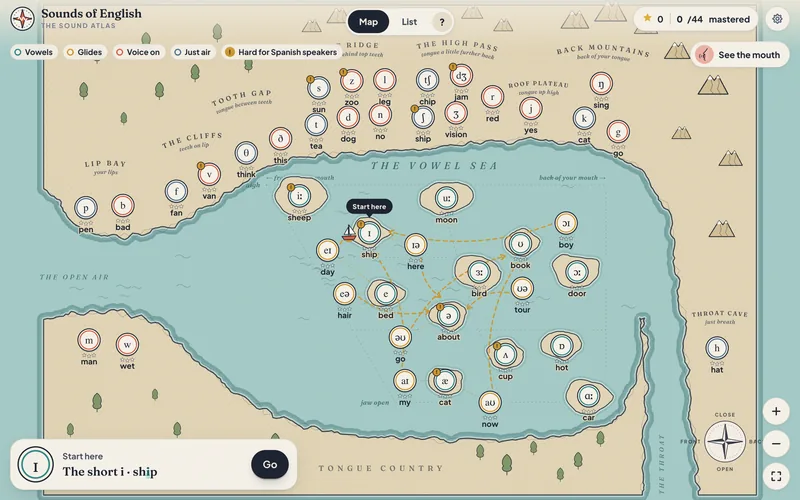
Sounds of English (inside Native Phrase Lab, and the free version at /sounds/play/) uses your microphone when you choose to record yourself. Your recordings stay on your device: they are kept in your browser while you practise and are not uploaded. Your progress in it is saved in your own browser and, in the full version, also with your key in the same way as Native Phrase Lab, so it follows you to your other devices. That includes the name you type for your certificate. The one exception is the optional “Can the computer understand you?” test: when you use it, your browser sends that short recording to its own speech-recognition service (for example Google’s, in Chrome), which works under the browser maker’s privacy policy, not mine. You never have to use it.
The games, the level test and the pronunciation pages keep your scores, progress, level result and the name you type for a certificate in your own browser on this device. They are not sent to me or anyone else, and clearing your browser data removes them. Pitch Perfect uses your microphone only when you press Record. That recording stays in your browser and is deleted when you move to the next phrase.
So that one key can’t be shared around, I keep a coded record of which devices have unlocked each key: the random device IDs and the dates each one was first and last used. It contains no name, no email and no key, and a device drops off the record after 30 days without use.
When you join “Share with a friend”
If you join “Share with a friend”, I keep a scrambled code made from your email (not your email itself), your link, and the first name you choose to show. When someone buys with your link, I keep a scrambled code of their email and the purchase number, so I can check that each friend is real and is counted only once. I do this to run the programme and to stop cheating. I never keep names, emails or card details for it, and I delete the records after 24 months. While you are signed in on easyenglishwithjames.com/share/, one small sign-in cookie keeps you signed in. The page your friend opens sets no cookie. You can leave at any time on easyenglishwithjames.com/share/.
When you join my email list
If you type your email into a “Join free” box, it goes to Gumroad, which runs my email list. Gumroad first sends you an email with a button to confirm. Then I send you short emails: one useful word a week, and sometimes news about my lessons and apps. Every email has a link to leave the list, and you can leave any time. Your email is not shared with anyone else.
What I don’t do
- Nothing I have written on this site tracks or profiles you: no advertising tags, no analytics, no pixel of my own on any page.
- No selling, renting or sharing your data with anyone for marketing.
- No profiling and no automated decisions about you.
- No mailing list you didn’t ask to be on.
2. Cookies
My own pages set no advertising or analytics cookies. The only cookies I set are the unlock cookies described above, which are strictly necessary to give you the thing you paid for, and the “Share with a friend” sign-in cookie, which only exists while you are signed in to that page.
Booking happens on Calendly’s own site, not this one. This site doesn’t embed a booking calendar. When you choose a time or buy a lesson pack, you leave this site for Calendly, which sets its own cookies and may load its own third-party tools. That is governed by Calendly’s privacy notice, and your payment there is processed by Stripe under Stripe’s privacy policy. I don’t receive that tracking data and I can’t see it.
YouTube videos embedded on this site set their own cookies when they load, governed by Google’s policy, linked below. They are not loaded at all until you click one. The site remembers two preferences in your browser’s own storage: whether you turned the sound on, and whether you’ve seen the opening animation. Neither is sent anywhere.
Campaign tags on links. If you arrive from one of my links that carries a campaign tag (for example, a link under a YouTube video), the site keeps that tag for the current browser tab only. If you then press a buy button, the tag is added to the Gumroad checkout link, so that Gumroad can show me which video or page led to a sale. The tag names the link that was clicked, not you. It holds nothing personal, it isn’t a cookie, and it’s gone when you close the tab.
3. Companies that process data on my behalf
- Netlify: hosts this site, counts page visits from its own server logs (no cookies, nothing added to the page), receives form submissions and stores the coded device records and synced progress for Native Phrase Lab. Their policy
- PayPal: payments. Their policy
- Gumroad: payments, digital delivery and my email list. Their policy
- Calendly: lesson booking. Their policy
- Stripe: lesson payments, taken through Calendly. Their policy
- Google (YouTube): embedded videos and the subscriber count. Their policy
Fonts are served from this site itself, so loading a page no longer sends anything to a font provider. I am a British national based outside the UK and the EEA, and these companies are largely in the United States, so your data may be processed outside your own country.
4. How long I keep things
- Enquiries and messages — kept while we’re in contact and for up to 2 years after, then deleted.
- Student records — while you’re studying with me and for 2 years after your last lesson, so I can pick up where we left off if you return.
- Purchase records — kept as long as I’m required to for tax and accounting.
- Native Phrase Lab device records: each device is removed after 30 days without use.
- Native Phrase Lab synced progress: kept while you use the app; reset it in the app or ask me, and it’s gone.
- Sound Check recordings — deleted within 30 days of sending your assessment, unless you ask me to keep them.
5. Your rights
Wherever you live, I’ll honour these:
- See it — ask what I hold about you and I’ll tell you.
- Correct it — tell me what’s wrong and I’ll fix it.
- Delete it — ask and I’ll delete it, except records I must keep for tax.
- Take it — ask and I’ll send you a copy.
- Object — tell me to stop using it and I’ll stop, or explain why I can’t.
Use the contact form and say what you want. No form to fill in, no fee, and I’ll reply within 30 days — realistically within a couple of days, because it’s just me reading it.
6. Children
These services are intended for adults. I don’t knowingly collect data from anyone under 16. If a young person is learning with me, that’s arranged with a parent or guardian, who is the person I correspond with.
7. Changes
If this policy changes materially, the date at the top changes and, where it affects you directly, I’ll tell you.
Written by a teacher, not a lawyer. It describes honestly what actually happens. If you spot something that looks wrong or is missing, tell me — I’d rather know.
TermsRefundsMain site